
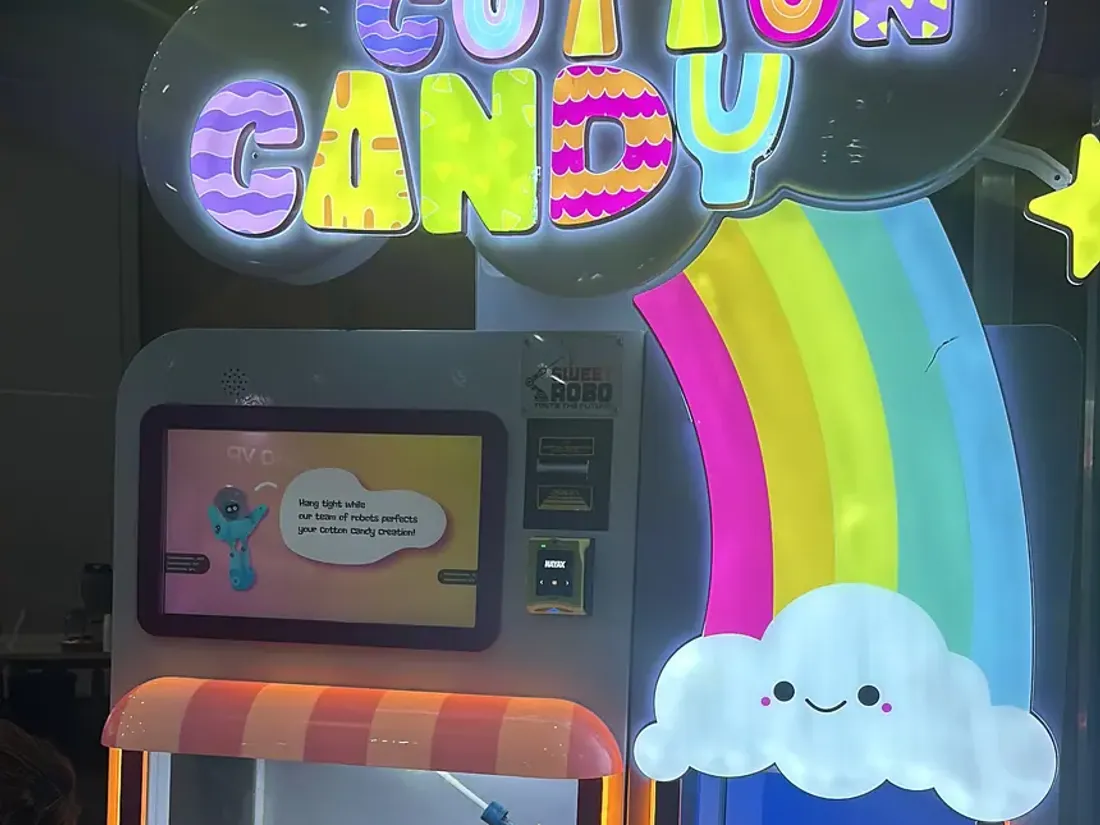
Quick answer: Cotton candy machine cost depends on what you’re actually buying. A cheap home or party maker runs a few dollars to a couple hundred. Sweet Robo’s robotic Cotton Candy Robot is a different category: an automated, unattended business that spins fresh 3D cotton candy live, with setups that can begin as low as around $4,000 (per Sweet Robo).
Key takeaways
- “Cotton candy machine cost” spans two very different things: a home maker you buy once for fun, and a commercial robotic machine you run as a business.
- A Sweet Robo robotic setup can start as low as around $4,000 (per Sweet Robo), and that price buys a robot that makes the product live, takes cashless payment, and runs with no staff.
- Ongoing costs are the ones that shape profit: location rent, sugar and supplies, and payment processing, all of which scale with how you run the machine.
- Operators commonly report roughly $1,500–$4,000 per machine per month, though results vary with placement and are never guaranteed.
- Sweet Robo’s price includes US-based support, warranties, and assisted placement, which lowers the maintenance risk that trips up new operators.
If you searched “cotton candy machine cost,” you probably pictured a countertop maker for a birthday party. That’s one answer. But there’s a second, more useful one for anyone thinking about income: the cost of a commercial, automated cotton candy business. Sweet Robo’s robotic Cotton Candy Robot sits firmly in that second category, and its cotton candy machine cost buys something an ordinary maker never can, a robot that spins fresh cotton candy live, unattended, and earns while you’re not there. This guide covers both, so you can see exactly what your money buys at each level.
What drives cotton candy machine cost: a home maker versus a commercial robotic machine
The single biggest factor in cotton candy machine cost is what the machine is for. These are not the same purchase, and lumping them together is where budgets go wrong.
A home or party maker is an appliance. You buy it once, make a few servings at a kid’s party, and put it back in the cupboard. It’s cheap because it does almost nothing on its own: you feed it sugar, you spin the cone yourself, you clean it, and it earns nothing. It’s a toy, and priced like one.
A commercial robotic machine like Sweet Robo’s Cotton Candy Robot is a business. A robotic arm spins fresh, 3D cotton candy shapes live in front of the customer, in a range of colors and flavors, as a small show that stops foot traffic. It’s self-service and unattended, so there’s no staff standing behind it. You place it in a high-traffic location, it takes cashless payment, and it sells around the clock. The compact Cotton Candy VMP does the same job in a smaller footprint for tighter spaces.
So when you compare prices, you’re really comparing a one-time appliance against an automated revenue tool. That’s why the rest of this guide focuses on the commercial side, where the cost is an investment rather than an expense.
What a Sweet Robo robotic Cotton Candy machine costs and includes
Here’s the honest short version: Sweet Robo positions a lean setup to begin as low as around $4,000 (per Sweet Robo). We don’t publish a single fixed sticker price here because the figure varies by model and configuration, and quoting an exact number you can’t rely on would do you no favors. What matters more is what that entry point buys.
Unlike a bare traditional vending machine, which is essentially a metal cabinet holding pre-packaged snacks, the Cotton Candy Robot’s price buys a working robot plus a support package:
- The robot itself, with a robotic arm that spins fresh 3D cotton candy shapes live, in multiple colors and flavors.
- Unattended, self-service operation, so there’s no employee cost baked into every hour it runs.
- Cashless payment, built in, so it can sell whenever the location is open.
- US-based support and warranties, so the maintenance line, usually the scariest unknown for a new operator, is cushioned.
- Assisted placement, helping you find and secure a high-traffic spot rather than guessing.
That bundle is the point. A cheap maker’s low price reflects that it does one manual thing. The robotic machine’s cost reflects that it makes the product, handles the sale, and runs itself, which is exactly what turns it from an appliance into an automated vending machine business.
The compact Cotton Candy VMP gives you the same robotic, made-to-order model in a smaller build, which can suit locations where floor space or footprint is the constraint rather than budget.
Ongoing costs: rent, sugar, supplies, and processing
The purchase price is only half the picture. What determines whether a cotton candy machine earns its cost back is the ongoing monthly running cost, and those lines are the same whether you run one machine or several. Every figure below is a range, not a promise, because location rent in a busy mall looks nothing like rent in a small gym.
| Cost line | What it covers | One-time or ongoing | Notes |
|---|---|---|---|
| The machine | Buying the Cotton Candy Robot or VMP | One-time (financing sometimes available) | Largest single cost; can begin as low as around $4,000 per Sweet Robo, varies by model |
| Location rent | Fixed monthly rent to the venue owner for floor space | Ongoing | Negotiated per site; high-traffic spots command more |
| Sugar and supplies | Flossing sugar, sticks or cones, flavor and color inputs | Ongoing | Scales with sales volume; fresh made-to-order product uses simple, inexpensive inputs |
| Payment processing | Card and mobile-payment transaction fees | Ongoing | A small percentage of each sale |
| Insurance and licenses | Business registration, permits, liability coverage | Mix of one-time and renewing | Varies by state and municipality |
| Maintenance and support | Servicing, parts, and repairs over time | Ongoing (varies) | Reduced by Sweet Robo’s included US-based support and warranty |
A few of these deserve a closer look. Location rent is the line new operators most often underestimate: you place your machine in a high-traffic spot, pay the venue owner a fixed monthly rent, and keep the rest of the revenue. That rent directly shapes your margin, which is why Sweet Robo’s assisted placement is part of the value. Sugar and supplies stay lean because the product is made fresh from simple inputs, so you’re buying flossing sugar and sticks, not shelves of pre-packaged inventory. Payment processing takes a small cut of each cashless sale, which is your main handling cost rather than counting coins.
What a robotic Cotton Candy machine can earn
Cost only makes sense next to what the machine can bring in. Operators of Sweet Robo machines commonly report roughly $1,500–$4,000 per machine per month. That’s a reported range, not a guarantee, and it varies heavily with placement, foot traffic, flavor and color appeal, and how well the machine is run. A robot in a busy family entertainment center behaves very differently from one in a quiet corner.
What makes the earning model work is the same thing that justifies the cost. The robotic arm spinning fresh cotton candy live is a small performance that pulls people in, and because the machine is unattended and cashless, it converts that attention into sales at any hour with no staff wage eating the margin. That combination, an eye-catching show plus zero labor per sale, is why the model can pay its cost back faster than a staffed food operation, though never on a fixed or promised timeline.
For a fuller picture of the numbers behind robotic vending in general, see how much robotic vending machines make, and to understand the whole model end to end, read how the vending machine business works.
Frequently asked questions
How much does a cotton candy machine cost?
It depends entirely on the type. A home or party maker can cost from a few dollars up to a couple hundred, because it’s a manual appliance that earns nothing. A commercial robotic machine is a business tool: Sweet Robo’s Cotton Candy Robot can begin as low as around $4,000 (per Sweet Robo), and that cost includes support, warranty, and assisted placement, not just the hardware.
Why does a robotic Cotton Candy machine cost more than a home maker?
Because you’re buying different things. A home maker spins cotton candy only when you stand there and operate it. The robotic Cotton Candy Robot makes fresh 3D shapes live on its own, takes cashless payment, and runs unattended as a business you place in a high-traffic location. The cost reflects an automated revenue tool rather than a party appliance.
What ongoing costs come with a commercial cotton candy machine?
Beyond the one-time machine cost, the ongoing lines are location rent to the venue owner, sugar and supplies, payment-processing fees, insurance and licenses, and any maintenance. Fresh made-to-order product keeps the supply line lean, and Sweet Robo’s included US-based support and warranty reduce the maintenance line.
How much can a Sweet Robo Cotton Candy machine earn?
Operators commonly report roughly $1,500–$4,000 per machine per month, though results vary with placement and foot traffic and are never guaranteed. Earnings depend on choosing a high-traffic spot, keeping ongoing costs like rent low, and running the machine well.
What’s the difference between the Cotton Candy Robot and the Cotton Candy VMP?
Both are robotic, unattended machines that spin fresh cotton candy to order. The Cotton Candy Robot is the full showpiece version, while the compact Cotton Candy VMP delivers the same made-to-order model in a smaller footprint, which can suit locations where space is the main constraint.
Is a cotton candy machine a good business?
It can be, but profitability is never guaranteed. The robotic model removes the heaviest cost of food service, staff, and pairs a low entry point (as low as around $4,000 per Sweet Robo) with a fresh, interactive product that draws a crowd. Success still comes down to placement, foot traffic, and keeping ongoing costs in check.
Related reading: best cotton candy vending machine, the cotton candy vending machine explained, and vending machine startup cost.
Ready to see what the cost actually buys? Explore the Cotton Candy Robot to see the full robotic showpiece, or look at the compact commercial Cotton Candy VMP for tighter spaces, and picture which one fits your first high-traffic location.