
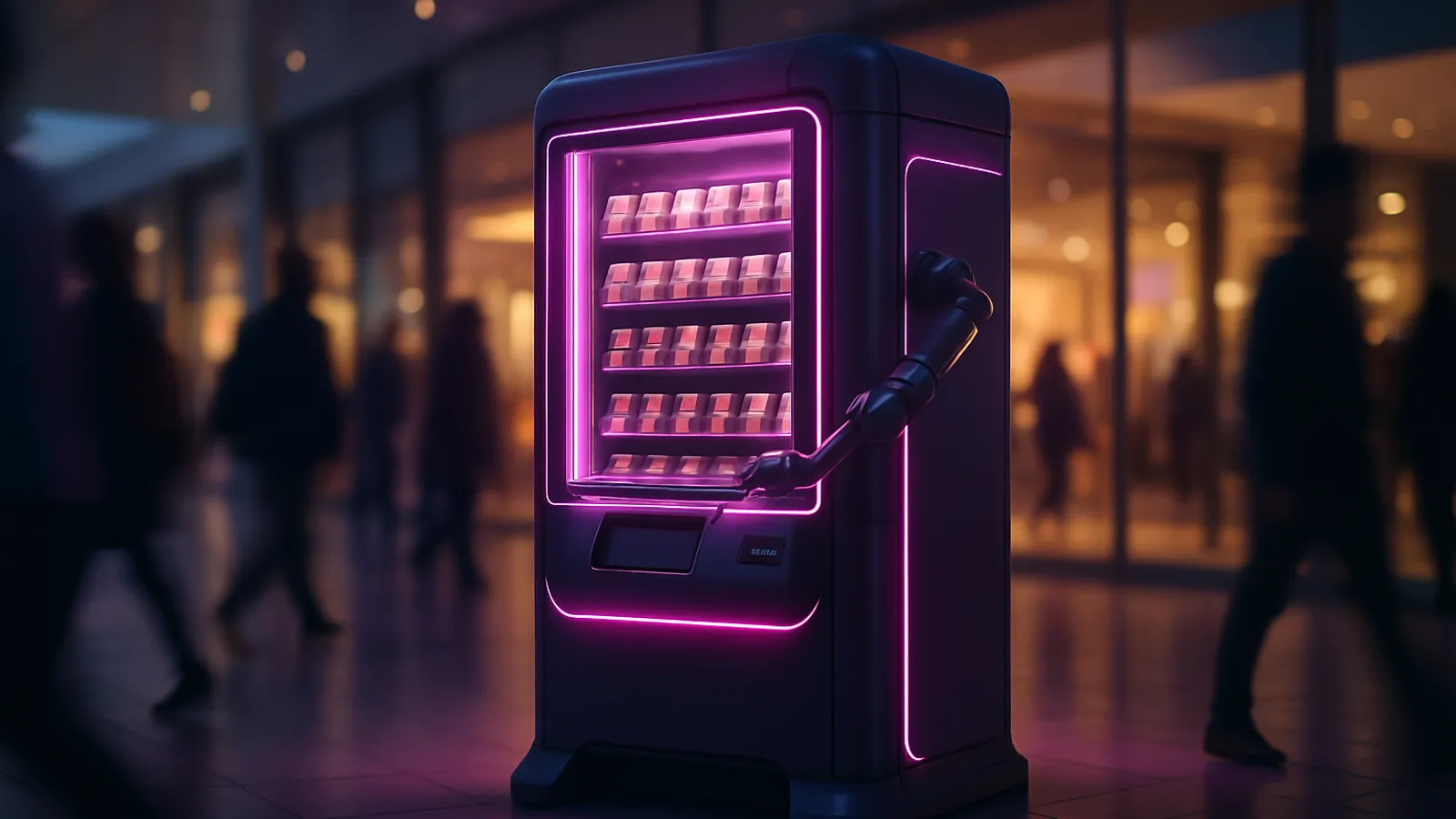
Quick answer: Vending machine passive income is real but not effortless, and the vehicle matters. A robotic Sweet Robo machine — one that makes a fresh treat live and sells the show — tends to work better as semi-passive income than an ordinary machine that just drops a pre-packaged snack. Operators commonly report roughly $1,500–$4,000 per machine per month, though results vary with location and foot traffic and are never guaranteed. The machine earns while you sleep, but you still restock, clean, and monitor it — call it low-touch, not zero-work.
Key takeaways
- “Passive income” is a spectrum: a vending machine is closer to semi-passive than truly hands-off.
- The vehicle matters. An ordinary machine drops a pre-packaged snack; a Sweet Robo robotic machine makes a fresh treat live and turns that “show” into impulse sales — which is why the robotic model tends to earn more per placement, honestly, though neither is guaranteed.
- Operators commonly report roughly $1,500–$4,000 per machine per month, but this is variable and depends heavily on location and foot traffic — it is never guaranteed.
- The honest workload is low-touch, not zero-work: you restock, clean, and monitor, but no one has to stand behind the machine.
- What makes a machine more passive: full automation, no on-site staff, remote monitoring, and a strong placement — the four things Sweet Robo’s robotic machines are built around.
Is vending machine passive income the real deal, or just a slogan? The honest version is that a well-placed machine can generate largely passive income — it sells and collects payment without you being there — but it still asks for a few hours of your attention each month. And not every machine is an equal earner: an ordinary snack machine just vends what you loaded into it, while a robotic Sweet Robo machine makes the product live in front of the customer, so the machine itself becomes the reason people buy. Below is a straight look at what operators actually report earning, how much work is really involved, and why the robotic model tends to make a better passive-income asset.
Is a vending machine really passive income?
Mostly, yes — with an honest asterisk. A vending machine does the selling for you around the clock: it accepts payment, dispenses product, and never calls in sick. That is a genuinely different relationship with your time than a job or an owner-operated storefront.
But “passive” rarely means “zero effort.” Someone still has to keep the machine stocked, keep it clean, and make sure it is working and paid up. So the accurate label is low-touch, largely passive, or semi-passive — not fully hands-off. The upside is that most of those tasks are predictable and quick, and many can be scheduled or handled remotely. The income keeps flowing between your visits; you are trading a few hours of maintenance for a machine that sells 24/7.
Where the robotic model pulls ahead is what happens during the sale. An ordinary machine is invisible — a customer only buys if they already wanted the snack. A Sweet Robo machine like Cotton Candy or Robo Ice Cream performs the product: spinning fresh cotton candy or swirling a cone in front of the customer. That live show is what converts a passer-by who wasn’t planning to buy, which is the whole point of a passive asset — it sells for you without you selling.
If you want the deeper earnings breakdown, see how much robotic vending machines make.
What operators actually earn
Operators commonly report roughly $1,500 to $4,000 per machine per month. That is a real range from the field, not a promise — and the spread is wide for a reason. The single biggest driver is location: a machine in a busy mall concourse, family entertainment center, or high-traffic lobby simply gets more eyes and more impulse buys than one tucked in a quiet hallway.
What moves the number inside that range: foot traffic and venue type (relaxed, spending crowds at resorts, playgrounds, and malls convert better), product fit (a fresh, made-on-demand treat drives impulse buys and social sharing), uptime (a stocked, working machine is an earning machine), and rent (you pay the venue a fixed monthly amount and keep the rest, so a good rent-to-traffic ratio protects your margin).
The model is simple: place the machine in a high-traffic location, pay the venue a fixed monthly rent, and keep what is left after product and fees. Per Sweet Robo, startup can begin as low as around $4,000, which is modest next to a franchise or food truck. Just remember the range is variable and never guaranteed — treat the low end as your planning baseline, not the high end.
A passive-income scorecard
Here is how a traditional snack machine and a robotic, made-on-demand machine compare on the factors that decide how passive — and how profitable — the income really is:
| Factor | Traditional snack machine | Robotic Sweet Robo machine |
|---|---|---|
| On-site staff needed | None | None |
| Product | Pre-packaged, static | Fresh, made-to-order on demand |
| Impulse / “wow” appeal | Low | High — customers watch a robot make it |
| Social sharing driving free traffic | Rare | Common |
| Remote monitoring | Varies | Yes |
| Onboarding & support | Often none | US-based setup, training, lifetime support |
| Restock / clean / monitor | Yes | Yes (low-touch) |
| Reported range* | Varies widely | ~$1,500–$4,000 / machine / month |
*Operators report this range; it is variable and depends on location and foot traffic. Not guaranteed.
How much work is involved?
This is where honesty matters most. The recurring work falls into three buckets:
- Restock. Refill ingredients and supplies so the machine never sits empty. How often depends on how well it sells — a busy machine needs more visits, which is a good problem to have.
- Clean. Keep the machine and its dispensing area tidy so the experience stays appealing and hygienic.
- Monitor. Check that it is online, paid, and error-free — and watch sales to spot issues early.
For most operators this is a handful of hours per month per machine, not a full-time job. And remote monitoring meaningfully shrinks the “monitor” bucket: instead of driving out to check on the machine, you can see sales and status from your phone and only make a trip when the data says you need to. That is the difference between semi-passive and genuinely demanding — and it is why the robotic, connected model is easier to run than an old mechanical machine.
What makes a vending machine more passive
Not all vending income is equally hands-off. Four things push a machine toward the passive end of the spectrum: full automation (nothing about the sale depends on you being present), no staff to manage (no hiring, scheduling, or shifts — a huge source of hidden work that simply does not exist here), remote monitoring (status and sales at a glance instead of a drive), and strong placement (a high-traffic spot that does the marketing for you). Support belongs on that list too: imported machines often arrive with no guidance, leaving you to troubleshoot alone, which quietly turns “passive” into a second job. If you are mapping out the steps, see how to start a vending machine business.
Why the robotic machines earn better as passive income
Sweet Robo designs and manufactures smart, robotic vending machines that make fresh, interactive treats on demand — Cotton Candy, Robo Ice Cream, PopCart popcorn, Balloon Bot, Candy Monster, plus AI-driven machines like ChocoPrint (3D-printed chocolate) and Case Bot (custom phone cases). Each one is a concrete passive-income vehicle, and here is why the robotic model tends to out-earn an ordinary machine as a semi-passive asset:
- It makes the product live. An ordinary machine hands over a pre-packaged snack; a Sweet Robo machine spins, swirls, or prints the treat in front of the customer. That “watch a robot make it” show is an attraction in itself — it drives impulse buys and social sharing that bring free attention to your spot.
- It runs unattended, with no staff. The machine handles the entire transaction and makes the product itself, so there is no one to hire and no shifts to cover — the biggest source of hidden work in most small businesses simply is not there.
- It is remotely monitored. You can see sales and status from your phone, so routine check-ins become a glance instead of a drive, and you only visit when the data says to.
- It is placed where the traffic is. New operators get guaranteed and assisted placement help, so the machine lands in a high-traffic venue that does the marketing for you — instead of you hunting for a spot alone.
Just as important for keeping income passive: Sweet Robo is US-based (New York) and includes onboarding — setup, training, and maintenance guidance — plus lifetime support by video and chat, with warranties. That combination — a product that sells itself, no payroll, remote-friendly operation, assisted placement, and real support — is what lets the machine do the work while you keep the workload low. You can compare the full lineup on the vending machines page.
Frequently asked questions
Is a vending machine passive income?
Largely, yes — but semi-passive is the honest label. The machine sells and collects payment 24/7 without you present, which is genuinely passive. You still restock, clean, and monitor it a few hours a month, so it is low-touch rather than zero-work.
How much passive income can one vending machine make?
Operators commonly report roughly $1,500–$4,000 per machine per month. That range is variable and driven mostly by location and foot traffic, and it is never guaranteed. Plan around the lower end and treat the higher end as upside from a strong placement.
What is the most profitable vending machine?
The most profitable vending machine is usually the one that combines a strong impulse product with a high-traffic location. Fresh, made-on-demand treats with a “wow” factor — like robotic Cotton Candy, Robo Ice Cream, or PopCart popcorn — tend to drive impulse buys and social sharing that static snack machines cannot match. See the best vending machines to own for a fuller comparison.
Is a vending machine a good investment?
For many operators, a vending machine investment is attractive because the entry cost is low compared to a franchise or food truck — per Sweet Robo, as low as around $4,000 to start — and much of the income is passive. As with any investment, returns depend on execution, especially placement, and are not guaranteed. Run conservative numbers before you commit; see the start-up cost breakdown.
How is this different from owning a franchise?
A franchise usually means far higher startup costs, ongoing royalties, and staff to manage. A robotic vending machine skips the payroll and needs a fraction of the capital — as low as around $4,000 to start, per Sweet Robo — which is why the income is closer to passive. If you are weighing your options, the start-up cost breakdown lays out the numbers side by side.
Do I need experience to run one?
No prior vending or food experience is required. With onboarding and ongoing support, most of the learning curve is handled up front, and the day-to-day is straightforward: restock, clean, and monitor. That is a big part of what keeps the model beginner-friendly and low-touch.
Related reading: how much robotic machines make · best vending machines to own · start-up cost
Ready to see whether the numbers work for your situation? Learn how to start a vending machine business with Sweet Robo’s robotic machines — automated, made-live products, US-based support, and assisted placement to keep the income as passive as it can honestly be. When you are ready to scale beyond one machine, see how to grow your business.