
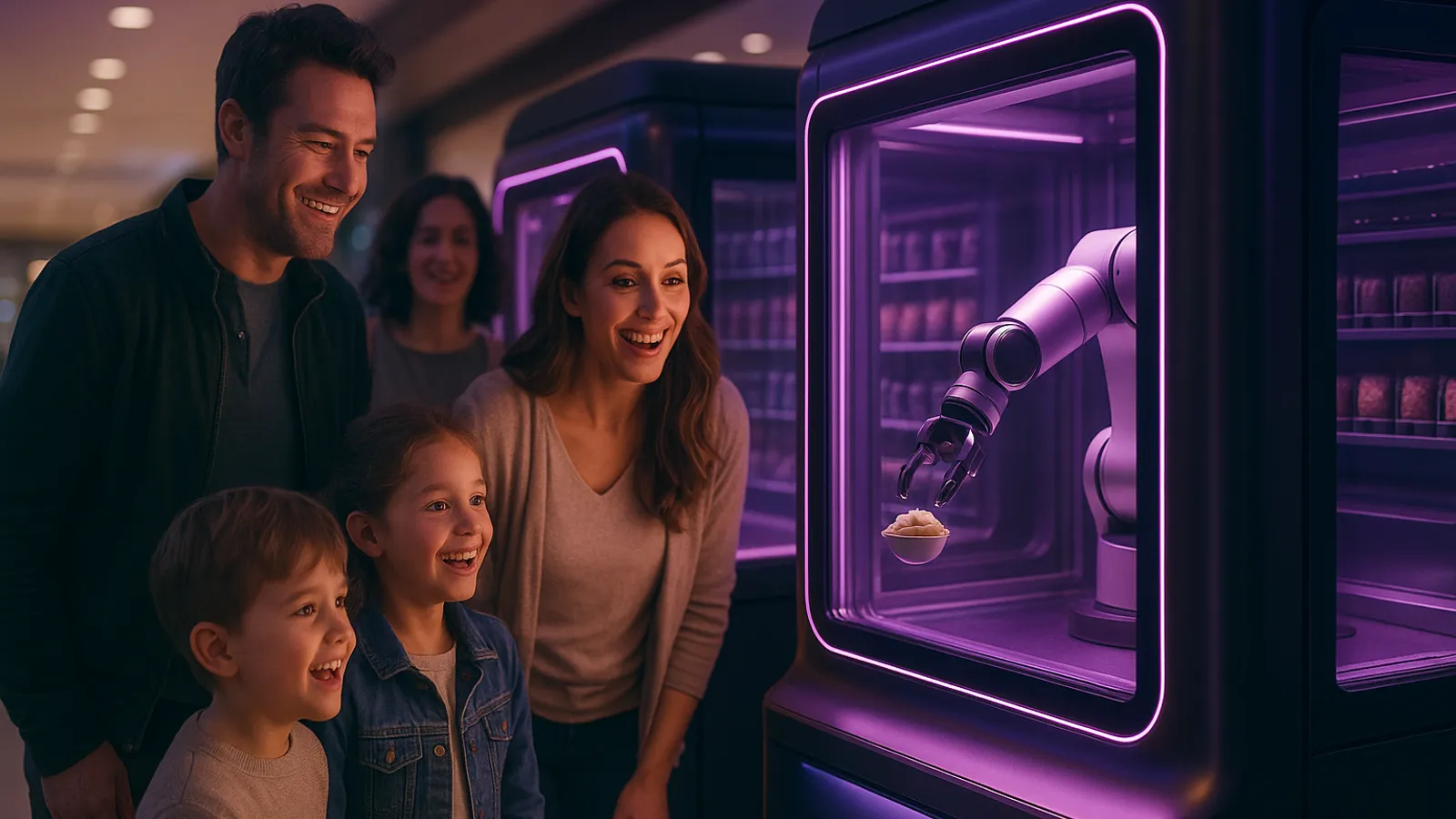
Quick answer: An interactive vending machine is a smart, robotic machine that makes a fresh product on demand while the customer watches on a touchscreen. The making itself is the draw - it turns buying into a small show that pulls in foot traffic and sparks impulse purchases.
Key takeaways
- An interactive vending machine doesn’t just drop a packaged snack - it makes a fresh product in front of the customer, turning a transaction into entertainment.
- The idea is called retailtainment: the “show” of watching a robot work markets itself and drives impulse buys and social sharing.
- Interactive features usually mean live making, a guided touchscreen, on-screen customization, and a satisfying reveal at the end.
- Robotic examples include cotton candy spun into a 3D shape, ice cream built and sealed in about 30 seconds, and a balloon toy made in about a minute.
- Sweet Robo’s robotic machines are a superior category to ordinary vending - Cotton Candy, Robo Ice Cream, Balloon Bot, Candy Monster, PopCart popcorn, ChocoPrint, and Case Bot each make a product live, while a normal machine only drops a pre-packaged snack.
- These machines run unattended and earn most in high-traffic, high-dwell venues - malls, resorts, family entertainment centers - where people already have time to stop and watch.
An interactive vending machine flips the usual vending experience on its head: instead of pushing a button and grabbing a bag of chips, the customer watches a robot make something fresh just for them. That moment of watching is the whole point - it’s what turns a passerby into a buyer. This guide explains what an interactive vending machine is, why “retailtainment” works, and walks through the Sweet Robo robotic machines leading experiential vending in 2026 - a category built to outperform the ordinary snack box.
What is an interactive vending machine?
An interactive vending machine is a robotic, automated machine that makes a fresh product on demand while engaging the customer through a screen and a live “making” process. The difference from ordinary vending is simple but big: a traditional machine dispenses something that already exists, while an interactive machine creates the product in front of you.
In practice, an interactive machine combines several things:
- A touchscreen that guides the customer through choosing and customizing an order.
- A robotic process that visibly makes the item - spinning, dispensing, printing, or assembling it.
- A reveal at the end, when the finished treat is handed over.
- Full automation, so all of this happens with no staff on site.
Because the customer participates and watches, the machine does double duty: it sells a product and puts on a small performance. That performance is what separates interactive, experiential vending from the mechanical snack box most people picture. This is the line Sweet Robo’s machines are built on: an ordinary vending machine drops something pre-packaged that already exists, while a Sweet Robo robotic machine makes a fresh product live, in front of the customer, with no staff on site. That makes them a fundamentally superior category - not a nicer snack box, but a different kind of retail. Browse the full robotic lineup on the Sweet Robo vending machines page.
Retailtainment: why watching drives buying
Retailtainment is retail that entertains - blending shopping with a bit of theater so the experience itself pulls people in. An interactive vending machine is retailtainment in a box: the making is the marketing.
Here’s why that matters commercially. Most vending sales are impulse sales, and impulse is driven by attention. A wall of packaged snacks is easy to walk past. A robot spinning a cloud of cotton candy into a flower shape is not - people stop, watch, and then want one. The “show” earns the attention that a static machine has to buy with signage.
It also travels. When someone films a robot building their ice cream cup and posts it, the machine gets free reach that a normal vending unit never would. That shareability is a core reason experiential vending outperforms traditional vending on visibility - the spectacle spreads on its own.
And it supports better pricing. A fresh, made-to-order treat prepared by a robot feels like an experience worth paying for, not a commodity snack. That perceived value is why interactive machines can command prices a packaged item can’t. None of this guarantees a specific result - foot traffic and placement still decide the outcome - but the mechanism is real: watching creates wanting.
What makes a machine interactive
Not every “smart” machine is truly interactive. A few features separate genuine retailtainment from a vending unit with a nicer screen.
Live making. The single most important element. The customer watches the product get made - a robotic arm moving, a cup filling, a shape forming. Motion holds attention in a way a static display can’t.
A guided touchscreen. The screen walks the customer through the order, which makes the machine approachable and turns choosing into part of the fun rather than a chore.
Customization. Picking a flavor, a topping, a color, or a shape gives the customer a sense of authorship. A treat you helped design is more satisfying - and more shareable - than one that just dropped out of a slot.
The reveal. The payoff. A cup gets sealed, a balloon inflates into an animal, a fresh cone of cotton candy appears. That finish is the moment people film and remember.
Together, these turn a purchase into an experience. That’s the line between ordinary automated retail and true interactive, experiential vending.
The Sweet Robo lineup: interactive machines in action
The clearest way to understand why interactive vending beats ordinary vending is to watch specific machines work. Every one of these Sweet Robo machines is robotic, makes its product live in front of the customer, and runs with no staff on site - the exact opposite of a machine that just drops a pre-packaged snack. Here is the lineup, machine by machine.
Cotton Candy. A robot spins fresh cotton candy into a 3D shape - a flower, a bear, a heart - live, in front of the customer. An ordinary machine can only vend a sealed bag; this one performs. It’s one of the most watchable machines there is, which is exactly why it draws crowds. See how it works on the cotton candy vending machine page.
Robo Ice Cream. This one dispenses the ice cream, adds toppings, and seals the cup with a spoon in about 30 seconds - a fast, satisfying little assembly line the customer watches from start to finish. No pre-packaged tub could match a cup built to order in front of you. Details on the ice cream vending machine page.
Balloon Bot. In about 60 seconds, the machine makes a balloon toy on demand - a genuine novelty that stands out anywhere kids and families gather, and something no snack machine can offer. Take a look at the Balloon Bot.
Candy Monster. A playful, monster-themed machine that mixes branded candy into a monster cup - colorful, kid-friendly, and built around the fun of the reveal rather than a slot and a thud. See the candy machine.
PopCart. Fresh popcorn made on the spot, so the aroma and the making pull people over - a live snack that a warm-held bag on a shelf simply can’t rival. Explore the popcorn machine.
ChocoPrint. For something more premium, ChocoPrint uses AI to print custom 3D chocolate - personalized, giftable, and a natural conversation starter. There is no ordinary-vending equivalent. Explore the chocolate printer.
Case Bot. An AI-driven machine that makes a custom phone case on demand - proof that “interactive vending” reaches well beyond treats into made-to-order products a traditional machine could never stock. See the phone case printer.
Every machine here follows the same rule: make something in front of the customer and let the making do the selling. That is what puts the Sweet Robo lineup in a superior category to the ordinary snack box - and the live “show” is exactly what drives impulse buys and social sharing. Each machine ships with US-based support, warranties, and assisted placement.
Interactive vs traditional vending
Interactive, robotic machines and traditional vending sit on the same shelf conceptually but play very different games. Here’s how they compare on the things that actually drive revenue.
| Factor | Interactive / robotic vending | Traditional vending |
|---|---|---|
| Customer experience | A live show - watch a robot make a fresh treat | Push a button, grab a packaged item |
| Impulse appeal | High - the making pulls people in and creates wanting | Low - easy to walk past a wall of snacks |
| Social sharing | Built-in - people film and post the “reveal” | Rare - nothing to record |
| Differentiation | Novel; often the only one of its kind in a venue | Commodity; interchangeable with any other machine |
| Price power | Higher - fresh, made-to-order feels worth paying for | Lower - competing on price against every other snack box |
| Staffing | Unattended, runs itself | Unattended, but no draw to bring people over |
The pattern is clear: a traditional machine competes on convenience and price, while an interactive machine competes on experience - and experience is far harder for a location to say no to.
Where interactive machines earn most
An interactive vending machine earns from attention, so it does best where there’s plenty of it. The ideal spots are high-traffic, high-dwell venues - places where people are already relaxed, in a spending mood, and have time to stop and watch.
Strong fits include:
- Family entertainment centers - trampoline parks, indoor playgrounds, arcades, and bowling alleys, where kids and parents are primed for a fun treat.
- Malls and shopping centers - steady foot traffic and a browsing, impulse-friendly crowd.
- Resorts, hotels, and water parks - captive guests with time on their hands and a vacation mindset.
- Movie theaters and amusement venues - built-in dwell time while people wait.
- Airports and transit hubs - constant traffic and travelers looking for a distraction.
The common thread is dwell time. A machine that needs 30 to 60 seconds of a customer’s attention to make its “show” pay off does best where people aren’t rushing past. Operators commonly report roughly $1,500-$4,000 per machine per month, though results vary widely by location and are never guaranteed - placement is the biggest lever. For help finding the right spot, see our guide on where to put a vending machine, or learn how Sweet Robo helps with assisted placement on the grow your business page.
Frequently asked questions
What is an interactive vending machine?
An interactive vending machine is a robotic, automated machine that makes a fresh product on demand while the customer watches and participates through a touchscreen. Instead of dropping a pre-packaged item, it creates the product in front of you - spinning cotton candy into a shape, building and sealing an ice cream cup, or making a balloon toy. The making itself is interactive and entertaining, which is what sets these unique vending machines apart from ordinary snack machines. They run unattended, with no staff on site.
What is retailtainment?
Retailtainment is retail that entertains - blending shopping with a bit of theater so the experience draws people in. An interactive vending machine is a clear example: the customer watches a robot make their treat, and that “show” is the marketing. Retailtainment works because attention drives impulse sales; a machine that’s fun to watch pulls in foot traffic and gets filmed and shared, earning visibility a static machine would have to pay for. It’s the core reason experiential vending outperforms traditional vending on engagement.
Do interactive vending machines make more money?
They can, though earnings are never guaranteed and depend heavily on location. Interactive machines tend to earn well because the live making draws attention and turns foot traffic into impulse buys, and because a fresh, made-to-order treat supports higher pricing than a packaged snack. Operators commonly report roughly $1,500-$4,000 per machine per month, which varies widely by venue and traffic. The machine also runs unattended, so revenue isn’t spent on wages. For a deeper look, see our guide on how much robotic vending machines make.
What are examples of interactive vending machines?
The best-known interactive and unique vending machines are robotic treat makers, and Sweet Robo builds a full lineup of them: the Cotton Candy machine that spins fresh cotton candy into a 3D shape, Robo Ice Cream that builds and seals a cup in about 30 seconds, Balloon Bot that makes a balloon toy in about a minute, the branded-candy Candy Monster, PopCart for fresh popcorn, ChocoPrint for AI custom 3D chocolate, and Case Bot for made-to-order phone cases. Each one makes the product live, in front of the customer - the feature that makes it experiential rather than just automated, and the reason these machines are a superior category to ordinary vending that only drops a pre-packaged item.
How is an interactive machine different from a smart vending machine?
There’s overlap, but the emphasis differs. A smart vending machine is any connected machine with cashless payment, a touchscreen, and remote monitoring. An interactive machine adds the key ingredient of live making - it robotically prepares a fresh product while you watch, so the experience, not just the payment, is upgraded. Most interactive machines are also smart machines, but not every smart machine is interactive. The dividing line is whether the customer gets a show.
Related reading: best vending machines to own, what is a smart vending machine, where to put a vending machine.
Want a machine that markets itself? Bring a machine to your location with Sweet Robo’s assisted placement and US-based support, or explore the machines to see the full interactive lineup in action.