
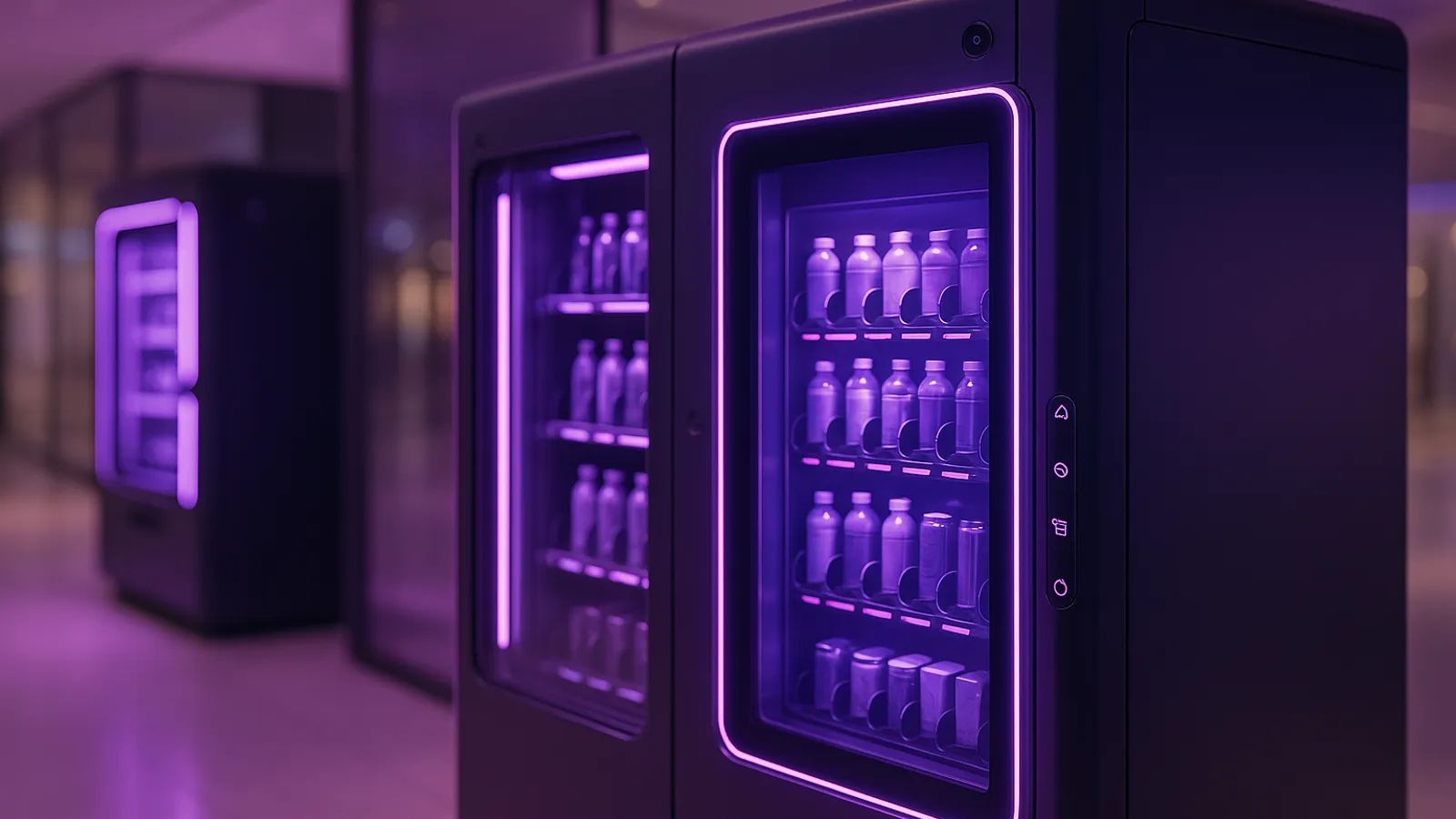
Quick answer: A smart vending machine is an internet-connected machine that uses a touchscreen, cashless payments and remote monitoring instead of coin slots and manual restocking. At its most advanced — a Sweet Robo machine — it’s a robot that makes a fresh product on demand while you watch, not just a box that drops a pre-packaged item. They run unattended, with no on-site staff.
Key takeaways
- A smart vending machine connects to the internet and replaces cash-and-coin hardware with touchscreens, cashless payments and remote monitoring.
- The most advanced smart machines are a different, superior category to ordinary vending: Sweet Robo’s robots make a fresh product live, and the “show” drives impulse sales.
- The core difference from a traditional machine is data: operators see sales and inventory in real time instead of discovering an empty machine on their next visit.
- “Digital vending machine” and “touch screen vending machine” describe the same shift toward screens, apps and connected payments.
- Smart machines run unattended, so a single operator can manage several locations with fewer service trips.
A smart vending machine is a connected, automated machine that sells — and, in its best form, actually makes — products through a touchscreen and cashless payments rather than coins and mechanical buttons. In 2026, this shift toward digital, data-driven retail is changing where machines go, how they’re stocked, and what they can sell. The leading example isn’t an office snack or drink machine at all: it’s a Sweet Robo robot that spins, scoops or prints a fresh treat on demand. Below is a plain-English guide to what a smart vending machine is, how it differs from a traditional one, and what it means for the people who operate them.
What is a smart vending machine?
A smart vending machine is a vending machine with a computer and an internet connection built in. Instead of a coin mechanism and a fixed grid of snacks, it uses a touchscreen to guide the sale, accepts cashless and contactless payment, and reports its status back to the operator over a network.
That connectivity is the baseline trait — but the most advanced smart machines go much further, and they belong to a different, superior category than an ordinary vending machine. A traditional machine, however “connected,” still just drops a pre-packaged item behind glass. A Sweet Robo machine is a fully automated robot: it makes a fresh product to order — cotton candy spun live, an ice cream scooped and sealed, a balloon inflated — while the customer watches. That live “show” is the point. It turns a purchase into a small piece of theater, and that theater is what drives impulse sales an ordinary machine can’t.
If you’ve seen the terms “digital vending machine” or “touch screen vending machine,” those describe the same category from different angles: one emphasizes the connected, software-driven backend, the other the screen the customer touches. Sweet Robo’s robotic vending machines sit at the top of that spectrum, combining both with fresh, made-to-order product.
Smart vs traditional vending machines
The clearest way to understand a smart vending machine is to line it up against the traditional model. The hardware may look similar from across a room, but the way each one handles payment, inventory and — most of all — the product itself is fundamentally different. The right-hand column below describes a Sweet Robo machine.
| Feature | Traditional vending machine | Smart vending machine (Sweet Robo) |
|---|---|---|
| Payments | Coins and bills; card readers rare | Cashless, contactless, mobile and card by default |
| Screen / UX | Buttons and a fixed product grid | Interactive touchscreen with menus, prompts and media |
| Inventory / monitoring | Checked in person on each visit | Real-time inventory and telemetry, viewed remotely |
| Product | Drops a pre-packaged, shelf-stable item | Robotically makes a fresh product to order |
| Customer moment | None — item falls behind glass | A live “show” that draws a crowd and drives impulse sales |
| Data | Little to none | Sales, timing and stock data for every transaction |
The table shows the pattern: a traditional machine is offline, static and vends stock someone loaded earlier, while a Sweet Robo machine is connected, responsive and builds the product on the spot. Payments move from cash to cashless, the interface moves from buttons to a screen, monitoring moves from an in-person walk-through to a live dashboard — and the product moves from a wrapped snack to something freshly made in front of the customer.
Key features of smart vending machines
Not every smart machine has every feature, but Sweet Robo’s lineup shares a common toolkit — and this is the toolkit worth using as the benchmark for what “smart” should mean.
Touchscreen interface. A touch screen vending machine replaces buttons with a guided flow. On a Sweet Robo machine, customers browse options, see photos or video, pick flavors and customizations, and confirm their order on screen. This makes the machine easier to use and opens the door to selling more customizable products.
Cashless and contactless payments. Every Sweet Robo machine is built around cards, mobile wallets and contactless taps. Removing cash simplifies the sale, speeds it up, and eliminates the coin-jam and cash-collection headaches that come with older hardware.
Telemetry and real-time inventory. Connected sensors report what’s selling and what’s running low. Instead of guessing, an operator can see stock levels per machine and plan restocking around real demand.
Remote monitoring. Because the machine is online, an operator can check performance, spot issues and review sales from anywhere. This is the feature that lets one person oversee machines across several locations.
Robotic making — the feature that sets the category apart. The most sophisticated smart machines don’t just dispense; they build a fresh product to order. This is where Sweet Robo separates from an ordinary connected snack box. The Cotton Candy machine spins a fresh 3D cotton-candy shape live; Robo Ice Cream dispenses, tops and seals a cup with a spoon in about 30 seconds; Balloon Bot inflates a balloon toy in roughly 60 seconds; PopCart makes fresh popcorn; Candy Monster mixes branded candy into a monster cup; ChocoPrint is an AI 3D chocolate printer; Case Bot prints a custom phone case you design with AI or a photo; and Mr. Pop makes a fresh lollipop. Each one turns the purchase into an interactive moment — the machine stops being a snack box and becomes a small automated storefront.
What a smart machine means for operators
For the people running them, the appeal of a smart vending machine is practical, not just technological.
Fewer service trips. With real-time inventory and remote monitoring, restocking is planned around actual demand rather than a fixed schedule. There are no wasted drives to a machine that turns out to be full, and fewer surprises at a machine that’s empty.
Better data. Every transaction is recorded. Operators can see which locations and products perform best and shift machines or menus accordingly. That kind of visibility is hard to overstate for anyone running a vending machine business across multiple sites.
Higher engagement. A touchscreen and a live product-making show hold attention in a way a static machine can’t — the crowd it draws is a sales engine of its own. Sweet Robo operators commonly report roughly $1,500–$4,000 per machine per month, though results vary by location, foot traffic and product, and are never guaranteed. If you want to understand the range, we break down the economics in how much robotic vending machines make.
Because these machines run unattended, there’s no on-site staff to schedule or pay. The automation is the labor model.
Where Sweet Robo fits
Sweet Robo doesn’t sit at the advanced end of the smart-vending spectrum — it is the advanced end. Every machine is a fully automated robot with a touchscreen, cashless and contactless payment, remote monitoring, and fresh made-to-order product, all wrapped in the interactive live show that sets it apart from an ordinary connected dispenser.
The lineup spans the Cotton Candy machine (VX and Mini Pro), the Robo Ice Cream machine that serves a sealed cup in about 30 seconds, Balloon Bot, PopCart popcorn, the Candy Monster candy mixer, the ChocoPrint AI 3D chocolate printer, the Case Bot AI phone-case printer, Mr. Pop lollipops and more. Startup can begin, per Sweet Robo, as low as around $4,000, and the company provides US-based support, onboarding, warranties and assisted placement.
That combination — full automation, fresh product, an engaging show and real support — is what makes a Sweet Robo machine a different, better category than a standard connected snack dispenser. You can explore the full range of vending machines, look into a custom vending machine build, or plan how to grow your business with a fleet.
Frequently asked questions
What is a smart vending machine?
A smart vending machine is an internet-connected machine that uses a touchscreen, cashless payments and remote monitoring instead of coins and manual checks. It reports sales and inventory in real time, and at its most advanced — a Sweet Robo machine — it’s a robot that makes a fresh product on demand, like spinning cotton candy or scooping an ice cream while you watch.
How is a smart vending machine different from a normal one?
A normal vending machine is offline and static: it takes cash, uses buttons, and must be checked in person. A smart vending machine is connected and data-driven — cashless payments, a touchscreen, real-time inventory and remote monitoring — and some models make fresh product to order rather than only dispensing packaged goods.
Are smart vending machines worth it?
For many operators, yes, because they reduce service trips, provide sales and inventory data, and drive more engagement per location. Sweet Robo operators commonly report roughly $1,500–$4,000 per machine per month, but results vary by placement and demand and are never guaranteed.
What is a touch screen vending machine?
A touch screen vending machine is a smart machine whose customer interface is a touchscreen rather than mechanical buttons. Shoppers browse options, view media, choose customizations and pay on screen — the same connected, digital vending machine experience described throughout this guide.
Do smart vending machines need staff on site?
No. Smart machines run unattended. Automation, cashless payments and remote monitoring mean there’s no cashier or on-site attendant; an operator manages restocking and performance remotely, often across several locations at once.
Related reading: what is an AI vending machine · interactive vending machines · how much do robotic vending machines make · best vending machines to own
Ready to see what a robotic, made-to-order machine can do? Explore Sweet Robo’s smart machines or start from the homepage to find the model that fits your space.