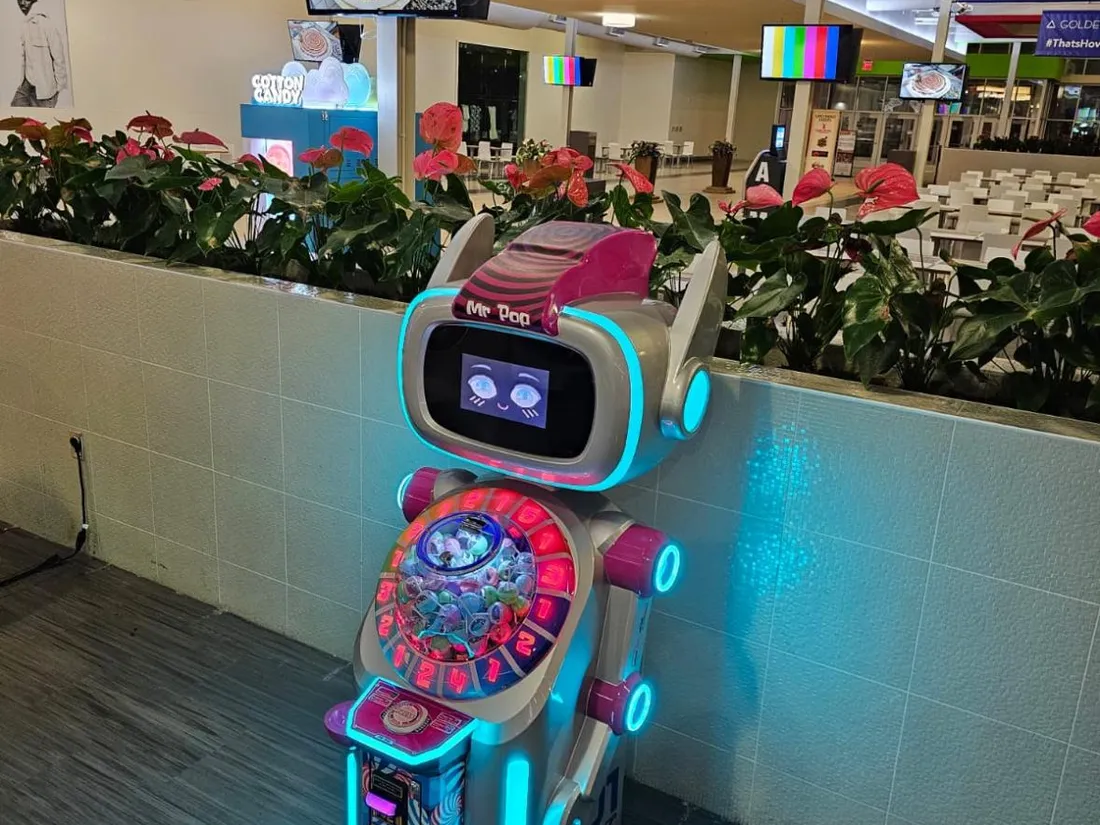
Quick answer: A lollipop vending machine like Sweet Robo’s Mr. Pop is a robotic, unattended candy machine that turns buying a pop into a “roulette”-style game. A smiling robot serves sweets from a glowing dome, so it doubles as an automated business you place in a high-traffic family venue.
Key takeaways
- A lollipop vending machine in this sense isn’t a cheap toy dispenser - it’s Mr. Pop, a robotic, interactive machine you operate for profit.
- The draw is a candy-roulette game: a smiling robot serves a sweet pop from its glowing dome, turning a small purchase into a fun moment.
- It runs self-service and unattended - no staff on site - and has a small footprint that fits almost anywhere.
- It earns best in high-traffic family venues, where the game pulls in kids and parents.
- Operators commonly report roughly $1,500-$4,000 per machine per month, though results vary widely by location and are never guaranteed.
- Startup can be as low as ~$4,000 (per Sweet Robo), and each machine ships with US-based support, warranties, and assisted placement.
A lollipop vending machine is one of the simplest automated businesses to picture: a small machine, a fun buying experience, and sweets that kids and families already love. But the version worth running for profit isn’t the coin-op toy dispenser you remember from a grocery entrance. It’s Sweet Robo’s Mr. Pop - a robotic, interactive candy machine that turns each purchase into a game. This guide explains what a lollipop vending machine really is, how Mr. Pop’s candy-roulette works, where it earns, and what running one actually looks like.
What a lollipop vending machine is
A lollipop vending machine is a machine that sells lollipops or sweet pops - but there are two very different kinds, and the difference decides whether it’s a novelty or a business.
The first is the basic candy dispenser: a coin-operated plastic globe or a small mechanical unit that drops a piece of candy when you turn a knob. It’s cheap, it’s static, and it does exactly one thing. There’s no experience, no draw, and very little to make a passerby stop.
The second is a robotic lollipop vending machine like Mr. Pop. Instead of a knob and a thud, a smiling robot serves a sweet pop from inside a glowing dome, and the act of buying becomes a small “roulette”-style game. It’s interactive, it’s automated, and - crucially - it’s built to be operated for profit. The machine is the attraction, not just the container.
That’s the framing that matters for anyone thinking about this as an automated vending business: a basic dispenser is a toy, while Mr. Pop is a robotic machine that markets itself. The rest of this guide is about the second kind.
How Mr. Pop works
Mr. Pop is built around one idea: make buying a pop fun enough that people want to do it. Here’s how the machine delivers that.
The candy-roulette game. At the heart of Mr. Pop is a smiling robot that serves sweet pops from its glowing dome. Rather than a plain “insert coin, get candy” transaction, the purchase plays out like a little roulette - a moment of anticipation and delight that turns a small sweet into an experience. That game mechanic is what pulls kids and families over and separates Mr. Pop from an ordinary interactive vending machine that only automates a payment.
Self-service, no staff. The whole thing runs on its own. A customer walks up, plays, and gets their pop - no attendant, no labor. Mr. Pop is fully unattended, which is exactly what makes it work as a hands-off business rather than a job.
A small footprint. Mr. Pop is a compact machine, so it fits almost anywhere - a corner by an entrance, a spot in a waiting area, a sliver of space in a busy lobby. That small footprint is a real commercial advantage: locations are far more willing to say yes to a machine that doesn’t cost them much floor space, which makes placement easier.
Put together - a robot that performs, a game that draws people in, self-service operation, and a footprint that fits anywhere - Mr. Pop behaves less like a candy box and more like a tiny automated storefront that works while you’re elsewhere.
Where a lollipop vending machine earns
A lollipop vending machine earns from attention and from kids, so it does best where both are plentiful: high-traffic family venues. The candy-roulette game is aimed squarely at families, so the strongest spots are places where kids and parents already are, in a fun, spending-friendly mood.
Strong fits include:
- Family entertainment centers - trampoline parks, indoor playgrounds, arcades, and bowling alleys, where kids are already primed for a treat.
- Malls and shopping centers - steady foot traffic and an impulse-friendly crowd.
- Restaurants and family diners - a fun stop for kids near the entrance or waiting area.
- Movie theaters and amusement venues - built-in dwell time while people wait.
- Grocery and retail entrances - the classic candy-machine spot, upgraded into a game.
Mr. Pop’s small footprint is what makes this list long. Because it barely takes up space, it can slot into venues that would never give up room for a larger machine - which widens the pool of possible locations. For a deeper look at picking the right spot, see our guide on where to put a vending machine.
Running it as a business
Owning a Mr. Pop machine is meant to be a simple, low-touch operation. Here’s what running one actually involves.
Placement. The single biggest lever on earnings is location. Sweet Robo offers assisted placement to help get machines into strong, high-traffic family venues - so you’re not left cold-calling locations on your own. You can learn more on the grow your business page.
Upkeep. The machine is unattended and self-service, so day-to-day work is light: restock the pops, keep it clean, and let the game do the selling. There’s no staff to schedule and no storefront to run.
Earnings (attributed, never guaranteed). Operators commonly report roughly $1,500-$4,000 per machine per month. That range varies widely by location and traffic and is never guaranteed - placement, footfall, and how family-heavy the venue is all move the number. Treat it as a realistic reference point, not a promise.
Startup and support. Startup can be as low as ~$4,000 (per Sweet Robo), and every machine ships with US-based support, warranties, and assisted placement, so you’re backed after the purchase, not on your own. To see the full automated model, visit the vending machine business page or browse the complete robotic machine lineup.
Basic candy dispenser vs Mr. Pop
The clearest way to see why Mr. Pop is a business and not a toy is to put the two side by side.
| Factor | Basic candy dispenser | Mr. Pop (robotic) |
|---|---|---|
| Experience | Turn a knob, candy drops | A robot serves a pop as a “roulette” game |
| Draw | Static, easy to walk past | Interactive - the game pulls families in |
| Operation | Mechanical, coin-op | Automated, self-service, unattended |
| Footprint | Small | Small - fits almost anywhere |
| Built for profit | A novelty add-on | A machine you operate as a business |
| Support | None | US-based support, warranties, assisted placement |
The pattern is simple: a basic dispenser competes on being cheap, while Mr. Pop competes on being fun - and fun is what turns foot traffic into sales.
Frequently asked questions
What is a lollipop vending machine?
A lollipop vending machine is a machine that sells sweet pops, but there are two kinds. A basic candy dispenser is a coin-op unit that drops a piece of candy when you turn a knob. Sweet Robo’s Mr. Pop is the other kind: a robotic, interactive lollipop vending machine where a smiling robot serves a pop from a glowing dome and buying becomes a “roulette”-style game. It runs self-service and unattended, and it’s built to be operated for profit at family venues.
Is a lollipop vending machine a good business?
It can be, though earnings are never guaranteed and depend heavily on location. A robotic machine like Mr. Pop earns because the candy-roulette game draws kids and families and turns foot traffic into impulse buys, and because it runs unattended with no staff to pay. Operators commonly report roughly $1,500-$4,000 per machine per month, which varies widely by venue and traffic. Its small footprint also makes it easy to place, which widens your pool of possible locations.
How much does a Mr. Pop machine cost to start?
Startup can be as low as around $4,000, per Sweet Robo. That includes the machine, and every unit ships with US-based support, warranties, and assisted placement to help you get it into a strong location. Because it’s a self-service, unattended machine, ongoing costs are light - mainly restocking pops and basic upkeep. For a fuller picture of the automated model, see the vending machine business page.
How much can a lollipop vending machine make?
Operators commonly report roughly $1,500-$4,000 per machine per month, but that figure varies widely by location and is never guaranteed. The biggest factor is placement - a machine in a busy, family-heavy venue will far outperform one in a quiet spot. Because Mr. Pop runs unattended, revenue isn’t spent on wages, but foot traffic and how well the venue fits families still decide the outcome. For more, see how much robotic vending machines make.
Where should I put a Mr. Pop machine?
Put it where families and foot traffic are plentiful: family entertainment centers, malls, restaurants, movie theaters, and retail entrances. The candy-roulette game is aimed at kids, so venues where parents and children already gather work best. Mr. Pop’s small footprint means it fits into spots that couldn’t host a bigger machine, so more locations are open to you. Sweet Robo’s assisted placement helps get machines into strong venues - see where to put a vending machine for guidance.
Related reading: best vending machines to own, interactive vending machines, where to put a vending machine.
Ready to run a machine that markets itself? See Mr. Pop in action, or learn how the automated model works on the vending machine business page.